Dave Lift
China’s top 10 home elevator brands are competing on comfort, safety, design, and energy performance. For homeowners, electricity use is no longer a minor detail. A compact elevator may travel only a few floors, yet repeated daily trips can create noticeable consumption. Standby lighting, ventilation fans, control systems, and inefficient motors often remain active between rides.
How to reduce home elevator energy consumption is therefore a practical question, not merely a marketing phrase. Dr. Gina Barney, a respected lift engineering consultant, has stated, “Energy use must be considered across the lift’s entire life cycle.” This principle matters when comparing Chinese brands. It encourages buyers to examine the motor, controller, traction system, standby settings, lighting, and maintenance plan together.
Small changes can become visible results. LED cabin lights reduce unnecessary demand. Sleep mode limits idle operation. A gearless traction machine can improve efficiency in suitable homes. Regenerative drives may return braking energy to the electrical system, although their value depends on traffic frequency and installation conditions. Correct counterweight design also matters.
The best choice is not always the model with the lowest rated wattage. Real performance depends on installation quality. It depends on usage, weather, door cycles, and servicing. Even a premium elevator wastes energy when its doors drag or sensors remain poorly calibrated. This article compares ten leading China home elevator brands and examines their practical energy-saving features. Some conclusions may remain imperfect. Product specifications can change, and laboratory figures do not always match a busy household. That uncertainty deserves honest attention.
China’s home elevator market is expanding beyond luxury villas. Urban homeowners now seek compact lifts for three-storey houses, renovated courtyards, and aging-family residences. The leading ten brands generally compete through safety systems, space-saving designs, quieter operation, and stronger service networks. However, market visibility does not always equal technical superiority.
A reliable review should compare certification records, factory experience, installer training, and after-sales response time. Ask whether technicians are available in your city. Check the shaft size, pit depth, overhead clearance, door width, and maximum load. A lift that fits a showroom may fail inside a narrow renovation project. Traction and hydraulic systems also differ in noise, maintenance, and energy demand. Request measured standby consumption, not only promotional efficiency claims.
Energy reduction depends on daily habits and equipment choices. LED cabin lighting, automatic sleep mode, efficient motors, and regenerative control can reduce unnecessary use. For a small family, standby power may matter more than peak motor power. Ask for service intervals and battery replacement costs, too. These details are easy to overlook. My own selection framework would still remain open to correction, because local climate, installation quality, and user frequency can change the result. A careful buyer should compare at least three technical quotations and inspect a completed residential installation before signing.
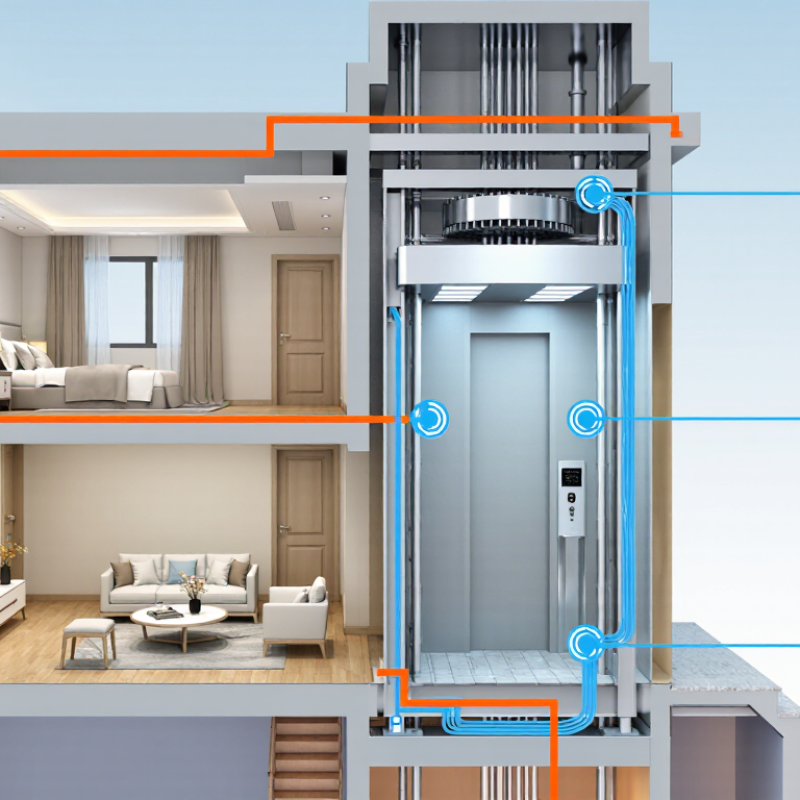
An elevator uses electricity in several distinct stages. Energy flows to the drive, control cabinet, lights, fan, door operator, and safety circuits. During a short trip, the motor may consume less than expected. Standby time matters more. In a typical home, the car waits for long periods between journeys. Controls and displays can still draw power while the lift is idle. Measurements from a power meter are more useful than brochure estimates.
Traction systems usually recover some energy when the car moves with a light load. That recovery depends on the drive design, travel pattern, and battery or grid connection. Hydraulic systems can use more power while lifting, especially in taller shafts. However, real performance varies. A two-storey lift with frequent stops may consume more monthly energy than a taller lift used twice daily. Door movement also adds small but repeated loads. Poor alignment can keep the operator working longer.
Residents can reduce demand by selecting LED cabin lighting, sleep-mode controls, and efficient door motors. Timers should switch lights and ventilation off after a practical delay. Service records should include standby watts, trips per day, and average load. These figures reveal waste that a single laboratory test may miss. Still, energy saving is not only a hardware issue. People often press the call button unnecessarily, then leave the car empty. That habit is minor, but it adds up. I would not promise dramatic savings without site measurements. Building layouts, climate, maintenance, and user behavior can change the result.
Leading Chinese elevator manufacturers are adopting several energy-saving technologies for residential projects. Permanent-magnet synchronous motors reduce mechanical losses and operate quietly. Gearless traction systems also remove transmission losses. Regenerative drives can return braking energy to a building’s electrical network during downward travel or upward loading. However, recovery depends on traffic patterns and control settings.
LED car lighting, automatic sleep modes, and low-power standby controllers reduce idle consumption. Smart sensors can switch off ventilation and displays when the car is empty. Destination-control software groups compatible calls, reducing unnecessary starts and stops. CIBSE Guide D, Transportation Systems in Buildings (2020), reports that lifts may use 2% to 10% of a building’s electricity, depending on traffic and operating conditions. ISO 25745-2 provides a method for measuring lift energy performance, helping owners compare real operating results instead of relying only on marketing claims. The IEA’s Buildings 2023 report also states that buildings consume about 30% of global final energy, making efficient vertical transport increasingly important.
Practical maintenance remains essential. A poorly adjusted door, worn guide shoe, or incorrect standby setting can waste energy every day. In my experience, technology is only half the solution. Data logging should check daily trips, standby hours, and regenerative output. Some systems look efficient on paper, but actual results may differ. That gap deserves honest review.
Reducing home elevator energy use begins with measurement. Record daily trips and standby hours for one week. A plug-in energy meter can reveal whether travel or idle operation consumes more electricity. In one household assessment, standby demand was higher than expected because the cabin lights and ventilation stayed active overnight. The first estimate was wrong.
Adjust the system step by step. Ask a qualified technician to set sleep mode after a suitable period of inactivity. Use efficient LED cabin lighting and motion sensors, but avoid overly short time settings. Frequent switching can reduce comfort and may increase maintenance needs. Keep doors, guide rails, and sensors clean. Poor alignment makes the motor work harder and can extend travel time. Never change control parameters without professional approval.
Daily habits also matter. Combine short trips when practical, and avoid sending the elevator empty between floors. Keep the rated load in mind; carrying unnecessary items adds demand. Schedule inspections according to local safety requirements, especially for brakes, cables, batteries, and drive components. Energy savings should never weaken emergency functions or accessibility. Review the meter after each adjustment, because a change that seems efficient may perform poorly in a real home. Small gains add up, but not every “green” setting is suitable for every household.
Modeled annual electricity consumption before and after practical energy-saving measures
This transparent planning model assumes 10 trips per day, 300 operating days per year, a 300 kg rated load, 5 m travel per trip, a 1.5 kW drive system, 200 W standby demand, and 70% overall lifting efficiency. The motion energy is calculated from E = mgh and converted to kWh. LED lighting, automatic sleep mode, and regenerative drive operation reduce consumption progressively. Actual results depend on travel height, traffic, equipment efficiency, and standby settings, so on-site metering should be used for final verification.
When comparing leading home elevator models in China, energy use should not stand alone. Gearless traction systems often reduce running power, while hydraulic systems may need more energy during lifting. Check standby consumption, because the elevator may wait in your home for many hours. A 300-kilogram lift carrying one person can still waste power through old lighting, poor controls, or frequent unnecessary trips.
Safety deserves closer attention than glossy finishes. Look for door sensors, emergency lowering, battery backup, overspeed protection, manual rescue procedures, and clear inspection records. Ask how the elevator behaves during a blackout. Does it stop softly at the nearest floor? Maintenance also affects safety. Confirm service intervals, technician response times, replacement-part availability, and the cost of annual inspections. A low purchase price can become expensive when the controller or door motor fails. I have seen buyers focus too heavily on appearance. That is an easy mistake.
Tips: Request written figures for standby and operating energy. Compare warranty exclusions, not only warranty length. Measure the shaft, pit, and overhead space before choosing a model. Ask for two maintenance quotations from local providers. Check noise levels during acceleration and door closing. Listen carefully. Also, leave room for doubt: advertised efficiency may reflect ideal testing, not a busy household with children, groceries, and repeated short trips.
| Profile | Drive System | Typical Rated Load | Typical Speed | Approx. Standby Power | Estimated Annual Energy Use | Key Safety Features to Verify | Recommended Service Interval | Typical Annual Maintenance Cost | Indicative Installed Cost | Energy-Saving Potential |
|---|---|---|---|---|---|---|---|---|---|---|
| 1 | Gearless traction with counterweight | 250–450 kg | 0.30–0.63 m/s | 30–80 W | 150–320 kWh | Door interlock, overspeed governor, emergency brake, battery lowering, overload protection | Every 2–3 months | ¥2,500–¥5,000 | ¥180,000–¥320,000 | Very high |
| 2 | Geared traction with counterweight | 250–450 kg | 0.30–0.50 m/s | 50–120 W | 280–520 kWh | Mechanical brake, door locks, overspeed protection, emergency alarm and lighting | Every 2–3 months | ¥3,000–¥6,000 | ¥160,000–¥290,000 | High |
| 3 | Hydraulic, direct-plunger | 300–500 kg | 0.15–0.30 m/s | 20–60 W | 900–1,800 kWh | Check valves, rupture valve, emergency lowering, door interlocks, overload sensor | Every 1–2 months | ¥3,500–¥7,000 | ¥170,000–¥300,000 | Low |
| 4 | Hydraulic, roped or indirect | 300–500 kg | 0.20–0.40 m/s | 25–70 W | 700–1,400 kWh | Rope safety device, check valves, emergency lowering, door locks and overspeed protection | Every 1–2 months | ¥3,500–¥7,000 | ¥190,000–¥330,000 | Low to medium |
| 5 | Screw-driven residential lift | 250–400 kg | 0.10–0.20 m/s | 20–60 W | 500–1,000 kWh | Mechanical safety nut, slack-chain protection, door interlocks, emergency descent | Every 3 months | ¥2,500–¥5,500 | ¥150,000–¥280,000 | Medium |
| 6 | Vacuum pneumatic lift | 180–250 kg | 0.15–0.30 m/s | 10–40 W | 250–600 kWh | Controlled descent, vacuum monitoring, emergency air inlet, door locking system | Every 3–6 months | ¥2,000–¥4,500 | ¥220,000–¥400,000 | Medium to high |
| 7 | Drum-drive traction lift | 250–400 kg | 0.15–0.30 m/s | 40–100 W | 400–850 kWh | Brake monitoring, cable safety device, door interlocks, overspeed and overload protection | Every 2–3 months | ¥3,000–¥6,000 | ¥150,000–¥280,000 | Medium |
| 8 | Machine-room-less permanent-magnet traction | 250–450 kg | 0.30–0.63 m/s | 25–70 W | 160–340 kWh | Electromechanical brake, door locks, emergency battery lowering, overspeed and overload protection | Every 2–3 months | ¥2,800–¥5,500 | ¥200,000–¥360,000 | Very high |
| 9 | Belt-driven traction lift | 250–400 kg | 0.20–0.40 m/s | 25–75 W | 180–380 kWh | Belt tension monitoring, brake system, door interlocks, overspeed governor and emergency lowering | Every 2–3 months | ¥2,500–¥5,500 | ¥180,000–¥330,000 | High |
| 10 | Traction lift with regenerative drive | 250–450 kg | 0.30–0.63 m/s | 30–80 W | 120–280 kWh | Regenerative braking, emergency brake, door interlocks, overspeed, overload and battery rescue | Every 2–3 months | ¥3,000–¥6,000 | ¥220,000–¥400,000 | Exceptional |
Compare safety records, factory experience, installer training, and local service response. Market visibility does not always prove technical superiority.
Check shaft size, pit depth, overhead clearance, door width, and rated load. A showroom model may not fit a narrow renovation.
Not always. Standby controls, lights, ventilation, and displays may use power for many idle hours.
Record trips and standby hours for one week. Use a suitable power meter instead of trusting brochure estimates.
Traction systems may recover some energy during certain movements. Hydraulic systems can need more power while lifting, especially in taller shafts.
LED lighting, sleep mode, efficient door motors, and practical timers can reduce demand. Avoid settings that switch equipment too frequently.
Combine short trips when practical, and avoid sending an empty car between floors. Small habits add up, though the savings may be modest.
Clean doors, guide rails, and sensors help the system operate smoothly. Poor alignment can extend travel time and increase motor effort.
Request inspection intervals, battery replacement costs, and local technician availability. Records should cover standby watts, daily trips, and average load.
No. Emergency functions and safe access must remain unchanged. Review every adjustment with a qualified technician, because an efficient setting may perform poorly at home.
China’s home elevator market offers a wide range of solutions for villas and multi-level residences, with selection typically based on safety, space requirements, ride comfort, reliability, maintenance support, and total cost of ownership. Energy use depends on factors such as motor type, lifting capacity, travel frequency, standby power, lighting, control systems, and installation conditions. Understanding these factors helps homeowners compare products more objectively rather than focusing only on the purchase price.
How to reduce home elevator energy consumption begins with choosing an appropriately sized system and an efficient drive with smart standby controls. Homeowners can further reduce usage by using LED lighting, automatic shutdown features, energy recovery technology where suitable, and regular maintenance to prevent mechanical resistance or control inefficiency. Before buying, it is important to compare verified efficiency data, safety functions, service requirements, warranty coverage, replacement-part availability, and long-term operating costs. A balanced decision can deliver dependable performance while lowering electricity use and household expenses.
